
Trip Prep
So you've been thinking about a trip across Africa. Well, here's everything you need to start!
- North to South or South to North
- When to Leave
- Carnet De Passage vs. Temporary Import Permit
- Vaccines
- Malaria
- Countries and Places to Avoid
- Buying a Vehicle in Africa
- Selling Your Vehicle in Africa
- Shipping Your Vehicle
- Storing Your Vehicle
- Insurance
- SIM Cards
- Passport Pages
- Photography and Drones
- South to East or East to South
North to South or South to North
95% of overlanders travel North to South due to logistics – they have their car in Europe or they rode or shipped to Europe and want to drive down. There’s no reason you can’t go the other way if you want to other than you will have to have a carnet if you ship your vehicle. You would ship into Cape Town and then ride up. The port of Rotterdam is the cheapest place in the EU to ship into and out of in case you’re wondering. Chances are you’ll meet very few travelers heading this way, so if you want peace and solitude from other overlanders or if you’re leaving at the wrong time of the year, South to North may be your vibe.
When to Leave
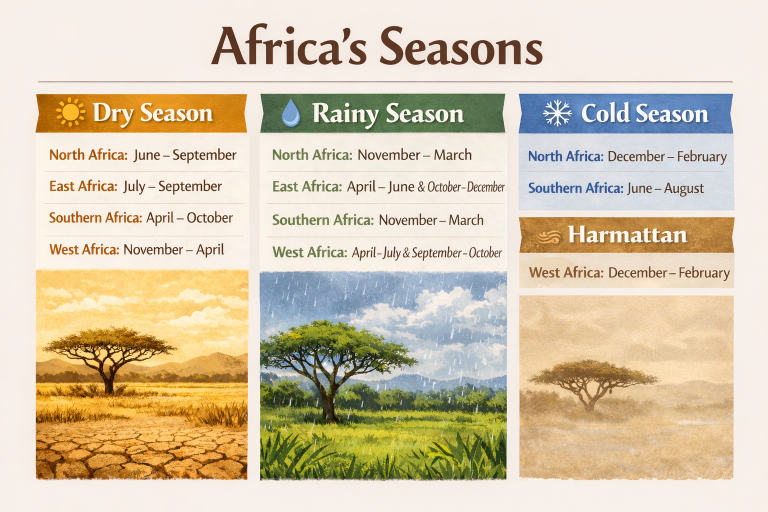
Here’s a photo of a the general weather in each region along your route and the rainy season. This has changed due to the global warming in recent years and there’s more rain in the dry season now and sometimes less during the rainy season but it generally still holds true. If you’re leaving from Europe, an October or November departure is typically ideal. This helps you avoid the worst of the winds along with the heat of the Sahara desert as well as the majority of the rainy season in West Africa.
Carnet De Passage (CDP) vs. Temporary Import Permit (TIP)
This is one of the most frequently discussed topics when it comes to overland travel. So I’ll try to summarize things as much as possible here.
A Carnet de Passage is something like a passport for your vehicle. It is generally issued by an automotive club, to which you pay a deposit and a payment for the carnet itself (~$300). It is typically issued for one year from a date that you set and you will receive the deposit once it is returned to the issuing authority.
You DO NOT have to have a carnet issued from the same country where the vehicle is registered!
Popular CDP issuers (because of lower deposits and cost of the carnet) have been:
CK Autoturist (based in the Czech Republic)
https://www.autoturist.cz/karnet-cpd
Touring Club Schweiz (based in Switzerland)
The carnet smoothes things over a lot at certain African land borders and still is officially required for this route. You also face no additional costs for having your vehicle enter each country.
The negative aspect is that you have a good amount of money tied to the carnet, which if you’re on a budget already may be a large factor. So in general it’s less flexible (financially) yet gives you more peace of mind at land borders on a continent where things can change fast.
Temporary Import Permits (TIP) are pieces of paper that enable your vehicle to enter a particular country for a specified amount of time. Typically, on the African continent these are issued for anywhere between 30-180 days depending on the country. Senegal takes the cake with 3 days on the initial one though it can be renewed.
You typically have to buy TIPs at each border crossing with the average for the West African route being around $5-10 per TIP. They give you a bit more flexibility financially but they can come with more pains at certain borders.
On the west coast leg of the journey, Ghana has been country that historically has required a CDP for entry but in practice there are a couple of borders at present that will let you pass without one (March 2026).
In Senegal, if your vehicle was made more than 8 years ago, they will charge you 250 Euros for the import permit. This is rarely applied to motorbikes but it’s something to consider. Namibia and Togo also officially require a CDP but it is not currently (March 2026) being enforced.
In summary, you can currently ride the Western Route to Cape Town with only TIPs however there is some slight risk to this if conditions change on the your journey.
In the end the choice is yours, you need to figure out whether you value your financial freedom a bit more than possibly being stuck at a border for several hours or even days.
Why most people get CDPs:
They don’t want any border hassle
They have enough finances to pay for the deposit and don’t care about that money being tied up
They do not plan on selling the motorcycle at the end of your trip
Why people get TIPs:
They may not want thousands of dollars tied up as a deposit somewhere
They may prefer flexibility of being able to sell the vehicle in any country along the way
They don’t know how long their trip is or where it will end
Vaccines
For any trip through Africa, you’ll need a Yellow Fever vaccination certificate or an exemption. It is not checked frequently but the requirement is there for nearly every country in West Africa and most of East Africa. Once you have it, the yellow fever vaccine is good for life.
It’s normally a relatively expensive vaccine, especially in the U.S. and Canada so I recommend getting a shot in Senegal if you’re unable to have one done in your home country. There are several clinics that will do it for around 10 euros in Dakar including Institut Pasteur and will issue you a the International Vaccine certificate as well.
Other vaccines that you may want to think about getting:
Hepatitis (all of them)
Tetanus (you need a booster every 10 years)
Typhoid
Meningitis
Rabies
As always discuss this topic with your doctor or a medical professional about which vaccines are right for you for this trip. I am not a medical professional and my recommendations stem from my travel experiences.
Countries and Places to Avoid
As of March 2026, the countries you want to avoid while traveling overland are the following:
Mali
Burkina Faso
Niger
Northern Nigeria
To a slightly lesser degree:
Chad
Central African Republic
Northern parts of Benin, Togo, Ghana, and Guinea
As always check your government travel advisory websites and talk to locals on the ground and then make an informed decision of the current climate. Things on this continent change incredibly fast and situations can escalate from peaceful to chaos in a matter of hours. We all have different levels of risk we’re willing to take on.
Buying a Vehicle in Africa
This is not a terrible idea if you’re only doing a short stint around East Africa for a couple of months looping around back to where you started. For overloading the continent though this is generally a bad idea for a number of reasons. The first being bureaucracy. It is extremely difficult to get registration papers in your name in almost every country on the continent without being a legal resident. There are some exceptions (Tanzania, Botswana) but those both have a poor selection of motorcycles with dubious maintenance records. Buying a motorcycle in South Africa is theoretically possible if you are able to get a TRN but that’s rarely expedient without a good agent (read: bribe). The best option is to come with your own vehicle or ship it in.
What if I wanna buy the motorcycle there and ride it back to my country?
We get this question all the time and the short answer is DO NOT DO IT unless you plan on selling it for parts or throwing it away once you get to your country.
In Europe for instance the process of importing a motorcycle from outside the EU (even models that were sold in the EU) is quite complicated. Between import and customs fees, inspection fees, and also emissions fees you’ll spend several times more than the motorcycle is worth, not to mention months if not years of your time. I’m not even going to discuss the fact that many of the motorcycles in West Africa are ones that were stolen in Europe. So I highly recommend you DO NOT do this.
Selling Your Vehicle in Africa
Yes, you can sell your vehicle there but don’t expect to get top dollar for it or anywhere near the prices you’d get back in Europe or the U.S. It also depends which country you want to sell it in. Historically, Tanzania has been a good destination to sell.
A few things to note: South Africa is one of the worst places to resell a car or a moto on the continent because of its extremely protected auto industry (they have extremely high import tariffs on vehicles because many are produced there). So for someone to buy your car think that they’d have to pay a large amount on top of the sales price to register it.
For motorcycles people will still buy them from you but they’ll typically use them as “farm” vehicles. Expect to get about 60% of the sales price that you would get for your motorcycle in Europe in South Africa.
Also give yourself time to sell it, even most dealers on the continent don’t just have cash in hand to be able to buy your bike the same day. Don’t expect a quick offer and sale. If you give a good enough discount they’ll find the cash one way or another but in general it takes time. Count on at least 2-3 weeks to find a buyer on average.
If you’re selling a motorcycle in West Africa expect rock bottom prices due to the importation of many stolen motorcycles from around the world there. You’ll be competing with those.
Shipping Your Vehicle
The most common places to ship a vehicle back home from are Cape Town, South Africa and Mombasa, Kenya. Currently, a motorcycle runs about 800 Euros from Cape Town to Rotterdam in Europe.
If you’re shipping out of Cape Town, South Africa be sure to get a TIP at the border with Namibia! They are in the same customs union but a South African TIP makes things smoother. You have to actually ask for the TIP, they will not give you one on their own. If you have a CDP then you don’t have to worry about this.
On the other hand if you’re shipping into South Africa, Namibia or Kenya you will need a CDP.
For the West Coast Route (South Africa to Europe route), a great contact who many friends have shipped with is Duncan from African Overlanders:
For the East Coast Route (Kenya to Oman or Kenya to Europe) we recommend Mario Crating
Storing Your Vehicle
If you’re on a carnet then this will not be much of a problem for you. You can usually leave your vehicle in the country for the length of the carnet. For those on temporary import permits these are the countries where it has been relatively easy to store a moto for at least 6 months at a time, and fly out without issues. When you return you can leave the country without any problems as well.
Ivory Coast
Togo
South Africa
If anyone knows of others please get in touch!
Insurance
You’ll want to have travel (medical) insurance from home. As far as third party vehicle insurance you either buy that at the border, none is required, you buy a card that covers the region or its built into the price of fuel.
In Senegal you’ll want to get the ECOWAS Brown Card insurance this covers:
Benin, Burkina, Gambia, Ghana, Guinea, Guinea Bissau, Ivory Coast, Liberia, Mali, Niger, Nigeria, Senegal, Sierra Leone, Togo.
You can buy it at any number of insurance offices in Dakar or Saint Louis.
You can also purchase the CEMAC Pink Card which covers most of Central Africa as well or you can wait until Cameroon to purchase it. This one covers: Cameroon, Chad, Central African Republic, Congo, Equatorial Guinea and Gabon.
For Angola and the Democratic Republic of Congo I was never asked or offered insurance. I am not sure if it exists or if it’s necessary at all for foreign vehicles.
In Namibia, Botswana, and South Africa the medical damage insurance (the only one required by law) is covered by the Road Fund and is a part of the fuel tax. You are not required to buy any additional coverage. That being said if someone hits your car or you hit theirs, property damage is not covered.
As a general rule, don’t expect insurance to ever pay out on the continent as a whole. You should still definitely get it just in case you have an accident along the way. Your travel insurance company could also possibly deny your claim if you didn’t purchase the required insurance within the country.
SIM Cards
Unless you’re only planning on spending a day or two in a country, it’s almost always cheaper to buy individual SIM cards in each country you go to. The cost of data varies greatly across the region, as does the quality of providers and speeds. If you plan on working remotely or uploading large YouTube videos during your journey, I would say you’ll need wifi for the most part rather than a mobile connection in the majority of the region.
I will try to update this in the future with a country specific list of approximate pricing and recommendations for the best providers. Also in some countries it’s extremely difficult to buy a sim as a non-resident so it’s better to buy it at the borders from resellers – Nigeria is one such country for example.
Passport Pages
Be sure you have enough passport pages left and that your passport is valid for over a year when you begin the journey. Many of the countries issue full paper visas and for a couple more (Guinea and Cameroon) you may need sticker visas as well.
Both Namibia and South Africa tend to be extremely strict with their two empty and adjacent pages requirement for entry. With that in mind you’ll need approximately 10 pages for full page visas alone for the West Coast journey. That doesn’t include space for all the entry and exit stamps and other stamps (for instance Mauritania stamps your passport with a large stamp when you enter with a vehicle). I would recommend having at least 16-18 empty pages in your passport before starting this journey.
Photography and Drones
This question gets asked frequently as well. Morocco has a tight restriction on drones entering the country. If you’re coming by ferry from Spain you will certainly be asked multiple times if you have one. Some have declared it and had it sealed in a package and returned to them provided they don’t use it (if the seal were to be broken by the Mauritanian border, it would be confiscated).
On other occasions people have shipped it to Senegal which creates other issues (customs duties, finding a suitable shipping location, etc). Finally, several people have smuggled them in successfully. The choice of bringing or shipping the drone depends on the level of risk you’re willing to accept.
If you do this you should be warned that flying a drone in Morocco is pretty severely punished and there are military installations nearly everywhere along this route. I would highly discourage you to fly it if you do end up smuggling it in.
As for photos, use common sense like you would in your own country. People on this continent are humans just like you and me so please treat them as such. Some African cultures view photography as you stealing their soul (mostly in rural areas), so be sure you ask someone before taking candid photos.I’ve never had a problem asking people for photos, most are super happy about them, especially if you offer to WhatsApp them a copy later. As always kindness goes a long way.
This section is coming soon. I’ll be heading off from Cape Town to East Africa in June 2026. If you have info, as always I’m all ears 🙂